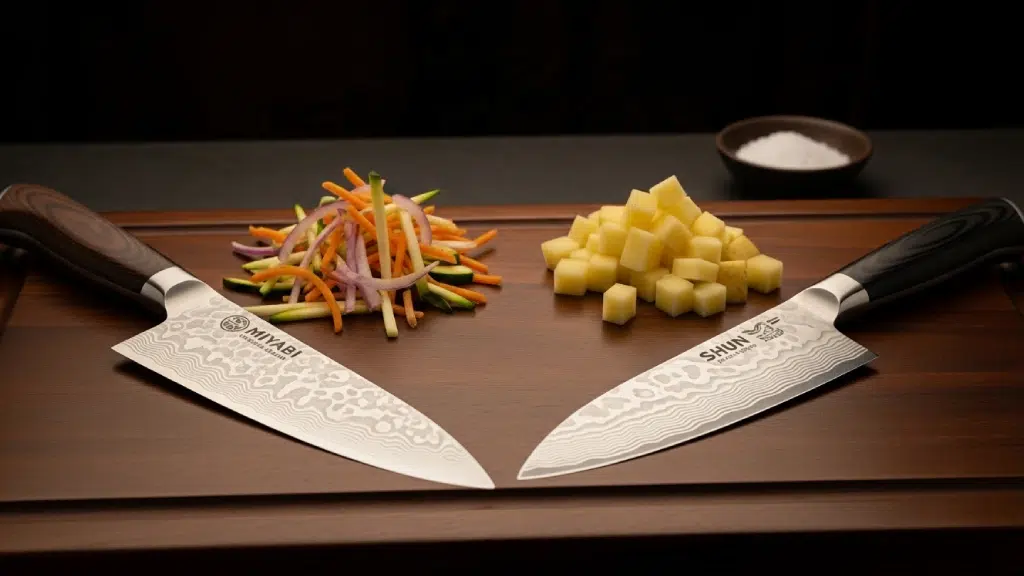
Miyabi vs Shun: Which Knife Should You Buy
You want razor-thin, glassy slices or a tougher everyday workhorse.
Miyabi gives ultra‑fine edges, higher HRC options (MC66/Kaizen) and exquisite polish for precise slicing. However, it needs softer boards and gentler use.
Shun uses VG‑MAX/VG‑10 dual‑core builds with thicker geometry, resilient tsuchime finishes and user‑friendly maintenance for busy cooks.
Pick Miyabi for finesse and Shun for durability. Keep going to see steels, angles, handling and real‑world tradeoffs.
Key Takeaways
- Miyabi emphasizes ultra-fine geometry and higher-HRC steels (up to ~66 HRC) for exceptional slicing and edge retention.
- Shun favors forgiving VG‑MAX/VG‑10 cores (~60–61 HRC) and thicker geometry for durability and everyday resilience.
- Choose Miyabi for delicate tasks (sashimi, paper-thin vegetables) if you use soft boards and gentle technique.
- Choose Shun for general home cooking, tougher ingredients, and lower maintenance with less risk of chipping.
- Trade-off: Miyabi gives razor precision but needs careful handling; Shun trades some sharpness for toughness and ease of care.
Miyabi or Shun: Complete Knife Comparison Chart
| Feature | Miyabi | Shun |
|---|---|---|
| Core Steel Options | MC66, VG-10 (Kaizen), SG2 in some lines | VG-MAX, VG-10, Dual-Core |
| Hardness (HRC) | ~60–66 HRC depending on series | ~60–61 HRC |
| Edge Angle | ~9° per side ultra-thin geometry | ~16° per side |
| Sharpness Level | Extremely sharp, razor-thin slicing performance | Very sharp but slightly thicker and more forgiving |
| Edge Retention | Excellent, especially with MC66 (~66 HRC) | Very good but slightly less than high-HRC Miyabi |
| Chipping Risk | Higher due to thin geometry and harder steel | Lower thanks to thicker, tougher blades |
| Blade Thickness | Thinner profile for precision cutting | ~50% thicker for durability |
| Damascus Layers | 32 layers per side with flowery pattern | 34 layers per side with hammered tsuchime finish |
| Blade Finish | Highly polished Damascus with refined aesthetics | Hammered tsuchime texture for food release |
| Tang Construction | Full tang with forward blade balance | Full tang with slightly handle-biased balance |
| Handle Materials | Composite or pakkawood handles with slimmer profile | Resin-stabilized pakkawood handles with fuller grip |
| Grip Feel | Sleeker and firmer for precise control | Rounder, warmer feel for comfort |
| Best Cutting Tasks | Sashimi, fine vegetable slicing, delicate presentation | General kitchen prep, chopping, tougher ingredients |
| Maintenance Needs | Requires softer cutting boards and careful use | Easier maintenance and more forgiving |
| Durability in Daily Use | More fragile due to thin edges | More durable for everyday cooking |
| Price Range | Premium pricing, especially MC66 lines | Mid to upper-range pricing |
| Ideal User | Experienced cooks who prioritize precision | Home cooks wanting reliable daily performance |
| Overall Character | Ultra-precise, high-performance slicing knife | Durable, versatile everyday kitchen knife |
Quick Decision Framework : Choose Miyabi or Shun by Skill & Budget

Decide whether Miyabi or Shun fits you by matching their strengths to your skill level and budget: if you’re an experienced cook who values ultra-fine edges and don’t mind investing in higher-HRC steel and softer cutting boards, Miyabi’s Kaizen or MC66 lines deliver superior sharpness and refined edge geometry.
If you want reliable, user-friendly performance at a broader price point, Shun’s Premier or Classic models are the more practical choice. They offer slightly thicker, less fragile edges and comfortable, durable handles.
You’ll pick Miyabi when you prioritize finesse: thinner geometry, polished edges, and peak slicing performance. Choose Shun for everyday versatility: robust edges, more forgiving maintenance, and ergonomics that lower fatigue.
Match blade feel to your technique and maintenance willingness. The Cangshan Olympus Series, with its 16° edge angle and balanced ULTRA6 heat treatment, represents an alternative that blends sharpness with long-term durability.
Miyabi vs Shun: Steel & Hardness Explained (VG‑MAX, VG‑10, MC66, HRC)
If you matched your technique and budget in the quick decision framework, the next step is understanding how the steels and hardness numbers affect performance.
You’ll find VG‑MAX (Shun) and VG‑10 (Miyabi Kaizen) sit close at 60–61 HRC, offering similar edge retention and daily durability with stainless resistance.
Miyabi’s MC66 in Black and Iki series jumps to ~66 HRC, giving superior long-term edge holding but demanding gentler use and softer boards.
Shun’s dual-core constructions alternate stainless layers for toughness and easier maintenance.
Higher HRC improves wear resistance but raises brittleness risk; you trade ease of resharpening for longevity.
Choose based on your maintenance willingness and cutting style: MC66 for ultimate retention and careful handling, VG‑MAX/VG‑10 for balanced, forgiving performance.
Shun’s blades also reflect their artisan craftsmanship in Seki City, Japan, balancing traditional techniques with modern performance.
Edge Geometry: Angles, Thinness, and Real‑World Sharpness
Think about edge geometry as the bridge between steel and real-world cutting. Angle, thinness, and micro-beveling dictate how a blade slices, how long it stays keen, and how forgiving it is under daily use.
You’ll notice Miyabi’s Kaizen finishes with a much finer apex and a 9° acute thinness. It slices exceptionally but asks for careful use on hard surfaces. Shun’s thicker profile tolerates abuse and resists rolling, trading ultimate bite for robustness.
You should match angle to task: thinner for slicing, slightly obtuse for chopping. Below is a quick comparative snapshot to guide your choice.
| Feature | Miyabi | Shun |
|---|---|---|
| Apex Angle | 9° | 16° |
| Thickness | Thinner | 50% thicker |
| Real-world use | Precision | Durability |
Shun’s use of VG-MAX steel and higher Rockwell hardness contributes to its long-lasting edge retention but requires careful maintenance.
Blade Construction & Finish (Damascus Layers, Tang, Honing)
Let’s take a closer look at how Shun and Miyabi build and finish their blades. Shun goes for 34 Damascus layers on each side, giving their knives a striking hammered finish. On the other hand, Miyabi opts for 32 layers, creating a beautiful flowery pattern that really stands out.
When it comes to tang and balance, both brands use a full tang design, but you’ll notice some differences. Shun’s Premier handles are rounder and a bit thicker, which shifts the balance in a unique way. In contrast, Miyabi’s composite grips offer a different feel, giving you more control.
Now, let’s talk about finishing and honing. Miyabi takes pride in its hand-ground three-stage honing process, which results in polished, rounded edges that are a joy to use. Shun, however, sticks to a 16° angle on each side, which gives their blades sharper, more squared edges. So, whether you prefer the elegance of Miyabi or the precision of Shun, each brings something special to the table!
Miyabi’s heat and cryogenic treatments also help deliver improved edge retention and corrosion resistance compared with untreated blades.
Damascus Layer Count
Compare the visible Damascus layer counts and finishes to understand how each brand signals quality and technique:
Shun builds its blades with 34 Damascus layers per side and a hammered tsuchime finish that emphasizes texture and light play.
Miyabi applies 32 layers per side arranged into a flowery pattern that highlights the blade’s aesthetic finesse.
You’ll notice Shun’s slightly higher layer count and tsuchime surface read as rugged refinement, masking minor imperfections and scattering reflections for utility-focused elegance.
Miyabi’s two fewer layers concentrate on pattern clarity and visual rhythm, pairing decorative layering with a finer polish that telegraphs artisanal control.
When you evaluate options, weigh Shun’s tactile contrast against Miyabi’s visual intricacy to match appearance with intended use.
Dalstrong similarly blends traditional layered Damascus forging with modern hand-finishing techniques to achieve consistent edge performance and aesthetic detail, often including Honbazuke honing to produce razor-sharp edges.
Tang And Balance
Seeing the damascus work up close helps you appreciate how each maker finishes the whole knife. That finish directly affects tang design and balance.
You’ll notice both Miyabi and Shun use full tang construction. However, Miyabi’s thinner, higher-HRC profiles push balance toward the blade for precise cuts. In contrast, Shun’s slightly thicker, girthier blades shift mass rearward for steadier chops.
You’ll feel the difference handling similar gyuto shapes versus more robust Premier styles.
- Miyabi: thinner blade, forward balance, favors delicate slicing and control.
- Shun: thicker blade, rearward balance, favors power and durability in prep work.
- Both: full tang stability, varying finish and damascus layering subtly tune hand feel and pivot.
Miyabi’s thinner grind and higher hardness often require less frequent honing when compared to some Western-style blades, benefiting from ice-hardening and precise edge geometry.
Honing And Finish
Examine the blades up close and you’ll immediately notice how finishing choices, such as Damascus patterning, tang treatment, and honing, define both look and function.
You’ll see Shun’s 34-layer Damascus with a hammered finish give visual texture and a slightly thicker profile, while Miyabi’s 32-layer flowery pattern reads finer and sleeker.
Both use full tang construction, but tang treatment and balance feel different in hand. Shun’s girthier tangs suit heavier prep, while Miyabi’s slimmer tang supports precise cuts.
Honing diverges: Miyabi’s hand-ground three-stage process yields a razor polish and rounded bevels ideal for delicate slicing, whereas Shun’s factory 16° per side edge produces a robust, sharp angle that’s easier to maintain.
Choose Miyabi for refined edges; choose Shun for everyday resilience.
A good maintenance routine includes using a proper honing steel to keep edges aligned between sharpenings.
Handles and Ergonomics: Pakkawood vs Composite Feel
While both Shun’s pakkawood and Miyabi’s composite handles aim for comfort and durability, you’ll notice different tactile and ergonomic priorities. Shun’s Premier and Classic models use compressed, resin-filled pakkawood that feels rounder and girthier in the hand. This offers a warm, wood-like grip and a slightly fuller palm fill.
Both aim for comfort, but Shun’s resin-packed pakkawood delivers a rounder, warmer, fuller-hand grip.
Miyabi’s composite handles prioritize a sleeker, more contoured profile with firmer, consistent texture. This design aids precision and control during push, tap, and slicing motions.
- Grip feel: Pakkawood gives a forgiving, slightly cushioned hold. Miyabi’s composite is firmer, reducing slip and increasing feedback.
- Shape: Shun favors fuller, traditional silhouettes. Miyabi narrows profiles for fingertip control.
- Balance: Pakkawood adds perceived handle heft. Composite shifts balance subtly toward the blade for agile work.
Cooking and storage tips for sugar-free hard candy often recommend using airtight containers and moisture control to maintain texture, as isomalt helps prevent stickiness and crystallization.
Durability, Chipping Risk, and Maintenance (Boards & Stropping)
Because higher hardness boosts edge retention but also raises chipping risk, you need to match board choice and stropping habits to the knife’s steel and geometry.
You’ll prefer softer wood or high-density polymer boards for Miyabi MC66 and Kaizen to cushion their 60–66 HRC edges and thin geometry. Harder plastic or glass can hasten micro-chips.
For Shun’s thicker, slightly softer blades (VG-MAX/FC61, 61 HRC), you can tolerate firmer boards with less risk.
When stropping, use light pressure and a fine compound on Miyabi to avoid rolling or chipping the acute edge. On Shun, slightly firmer, regular stropping restores the 16° per-side geometry.
Inspect frequently for burrs, use correct angles, and store knives to prevent contact damage.
Choose an appropriate honing steel length for your knives, such as a 9–12 inch stainless steel rod to match blade size and maintain consistent angles.
Best Use Cases: Who Should Buy Miyabi and Who Should Buy Shun?
If you’re after pinpoint precision for fine slicing, then Miyabi’s higher-HRC options and thinner geometry are definitely the way to go. They really excel in that area.
On the other hand, if you’re looking for something for everyday prep that focuses on comfort, toughness, and lower maintenance, Shun is a fantastic choice. It delivers reliable performance without requiring a lot of special care.
Now, if you’re an experienced cook who loves those razor-sharp edges and gentle cutting boards, you’ll really get the most out of Miyabi. But if you’re more of a generalist or a busy home cook, Shun will serve you well.
High-quality steels like German stainless steel often offer a good balance of durability and ease of maintenance.
Best For Precision Tasks
Choose Miyabi when you need razor refinement and ultra-thin geometry for delicate slicing. Pick Shun if you want a more forgiving, everyday precision that tolerates varied prep.
You’ll prefer Miyabi for tasks demanding micro-control, such as paper-thin vegetable slices, sashimi, and fine garnishes. Its thinner profile, higher HRC options, and polished edges deliver cleaner cuts. Shun fits when you want consistent, repeatable precision across tougher ingredients without constant stropping.
- Miyabi: superior edge thinness (9° zones, polished faces) for translucent slices and delicate presentation.
- Shun: thicker blade and robust geometry that resists micro-chipping during varied chopping and trimming.
- Skill match: choose Miyabi if you’re experienced and careful; choose Shun if you want reliable precision with less fuss.
Ideal For Everyday Prep
When you’re prepping for everyday meals, pick a Miyabi if you value razor-thin edges and refined slicing for vegetables, fish, and delicate presentation. Go with Shun when you want a more forgiving, all-purpose blade that handles tougher prep without constant maintenance.
You’ll choose Miyabi when you prioritize exceptional sharpness. Its Kaizen and MC66 lines give ultra-thin geometry and polished edges ideal for push-slicing and precise cuts, provided you use soft boards and gentle techniques.
Opt for Shun if you need durability and comfort. Thicker blades and robust handles absorb harder tasks like dense root vegetables and routine chopping with less chip risk.
In short, buy Miyabi for finesse and pristine slices. Buy Shun for resilient, lower-maintenance daily performance.
Suited For Experienced Users
Although both brands reward skilled hands, Miyabi is tailored for cooks who demand surgical sharpness and are comfortable tuning technique and maintenance.
If you value a wafer-thin edge, higher HRC options, and a polished three-stage honing finish, Miyabi gives you precision for fine slicing and delicate work.
If you prefer a slightly thicker, more forgiving blade that still performs daily without constant attention, Shun fits better.
Choose Miyabi when you regularly do tap, push chopping, and precise sashimi-style cuts.
Use softer boards to protect the high-HRC edge.
Choose Shun if you want reliable daily prep, easier maintenance, and a rounded handle that reduces fatigue.
Both reward skill, but Miyabi demands more adjustment and care.
Cost, Availability, and Recommended Models to Test in Store
Starting with budget, you’ll find Miyabi’s higher-HRC lines like the MC66 Black and Iki series command premium prices due to their harder steels and finer finishing.
You’ll pay less for Miyabi Kaizen or classic 60 HRC lines, while Shun Premier and Classic sit midrange. Dual Core models can push higher depending on rarity.
Availability varies: Shun is widely stocked at big retailers and specialty stores. Miyabi’s top lines often require dealer shops or online specialty sellers.
When testing in store, handle balance and edge feel matter. Try Miyabi MC66, Kaizen, Shun Premier, and Shun Classic.
Check weight, spine thickness, and immediate shave-slice performance. Bring a soft cutting board preference in mind for high-HRC Miyabi blades.
Frequently Asked Questions
Are Miyabi or Shun Knives Good for Left-Handed Users?
Yes, both Miyabi and Shun can work for left-handed users, but you’ll want to check specifics.
Miyabi’s symmetrical edges and polished, rounded bevels suit lefties well, though high-HRC models need careful use.
Shun’s 16° per-side grind is also ambidextrous, but their 90° blade-side geometry and thicker stock may feel different to left-handed techniques.
Choose symmetrical grinds and consider handle shape for comfortable control.
Can Either Brand Be Safely Used on Carbon Steel Pans?
Yes, you can, but don’t flirt with disaster: carbon steel pans are jealous and acidic, so you’ll need to act like a responsible partner.
You’ll protect both Miyabi and Shun by drying knives immediately, avoiding prolonged contact, and not leaving them sitting in the pan. Miyabi’s higher HRC and honed polish resist corrosion less, so oiling helps.
Shun’s stainless VG-MAX tolerates pans better but still benefits from care.
Which Brand Holds Value Better for Resale?
Expect roughly a 10–20% smaller resale dip for Miyabi over similar Shun models.
You’ll usually get better resale value from Miyabi when it’s a high-HRC, limited or MC66 piece because collectors prize harder steels and artisanal finishes.
Shun holds value well for everyday-use lines due to brand recognition and availability.
You’ll maximize resale by keeping knives mint, retaining boxes, and documenting purchase details and provenance.
Are There Travel-Friendly or Tsa-Compliant Options?
No, you can’t carry Miyabi or Shun kitchen blades in carry-on luggage through TSA; they’ll get confiscated.
You can pack them in checked baggage if sheathed and securely wrapped. However, higher-HRC Miyabi blades need good protection to avoid chips.
For travel-friendly options, choose TSA-compliant folding knives or purpose-built travel cutlery with blunt tips. Consider ceramic or plastic travel knives for flights.
Always check airline and country-specific rules before flying.
The Final Slice: Choosing Between Miyabi and Shun
You’re choosing a tool and a companion: Miyabi is the scalpel, cold, hard, cathedral-quiet precision. Shun is the poet’s knife, softer, more forgiving, with a wilder edge.
Match steel to skill, budget to patience. Think of Miyabi as a winter branch, crystalline and sharp; Shun as autumn leaves, lively and yielding.
Pick the blade that fits your hand, your rhythm, and the kitchen you want to shape every day.