Best Slow Roasted Prime Rib Recipe: Easy Cooking Guide
Choose a prime rib roast with ribs 6 to 12, weighing 6 to 10 pounds. Ensure a consistent fat cap and bright color.
Season generously with kosher salt, pepper, and optional herbs. Dry-age uncovered overnight.
Slow roast between 185°F and 250°F, monitoring internal temperature for medium-rare around 120–125°F.
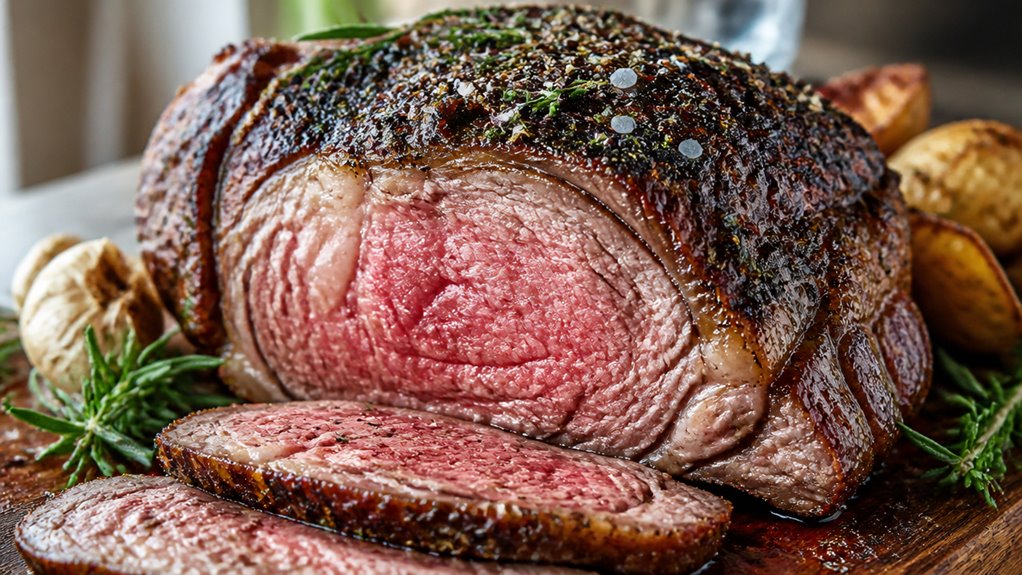
Rest well to redistribute juices before a high-heat sear at 500°F for a perfect crust. Learn how to master every step for ideal tenderness and flavor.
Key Takeaways
- Select a 6–10 pound prime rib roast from ribs 6–12 with a consistent fat cap and intact bone for even cooking and flavor.
- Season generously with kosher salt and black pepper, pat dry, optionally add garlic and rosemary, then refrigerate uncovered overnight.
- Slow roast at 185°F–250°F on a rack bone-side down until internal temperature reaches 120–125°F for medium-rare doneness.
- Rest roast uncovered or lightly tented for 15–45 minutes before a high-heat sear at 500°F to develop a rich crust.
- Carve against the grain with a sharp knife into ½-inch slices, serving immediately with au jus or horseradish sauce.
Prime Rib Recipe Table: Slow Roasting, Resting & Searing Tips
| Recipe Detail | Information |
|---|---|
| Main Term | Best Slow Roasted Prime Rib Recipe |
| Recipe Type | Slow-Roasted Beef / Prime Rib |
| Recommended Roast Size | 6–10 pounds |
| Preferred Ribs | Ribs 6–12 |
| Best Cut Features | Well-marbled ribeye section, consistent fat cap, intact bone |
| Main Seasoning | Kosher salt and freshly ground black pepper |
| Optional Seasonings | Garlic, rosemary, mustard powder |
| Dry-Aging/Seasoning Time | Refrigerate uncovered overnight or up to 48 hours |
| Room-Temperature Rest Before Roasting | About 2–3 hours |
| Slow-Roasting Temperature | 185°F–250°F |
| Medium-Rare Pull Temperature | 120–125°F |
| Rare Temperature | 115–120°F |
| Medium Temperature | 132–135°F |
| Rest Before Searing | 15–45 minutes |
| Final Searing Temperature | 500°F |
| Searing Time | 5–15 minutes |
| Carving Thickness | About ½-inch slices |
| Carving Technique | Slice against the grain |
| Serving Suggestions | Au jus or horseradish sauce |
| Key Cooking Tool | Instant-read or leave-in digital thermometer |
| Main Technique | Slow roast first, rest, then finish with high-heat sear |
| Storage | Refrigerate cooked prime rib for 3–4 days |
| Freezer Storage | About 2–3 months for cooked prime rib |
Choose the Best Cut for Slow Roasted Prime Rib

Start by selecting a prime rib roast with a well-marbled ribeye section, ideally from ribs 6 through 12 of the beef primal.
This choice guarantees tenderness and flavor due to intramuscular fat. Look for a roast weighing between 6 and 10 pounds for manageable cooking times and even heat distribution.
Confirm the presence of a consistent fat cap; it bastes the meat during roasting and helps develop a rich crust. Choose a roast with an intact bone for better heat conduction and stability on the rack.
Avoid cuts with uneven thickness, as they cook unevenly. When purchasing, inspect color—it should be a bright, cherry red without dark spots.
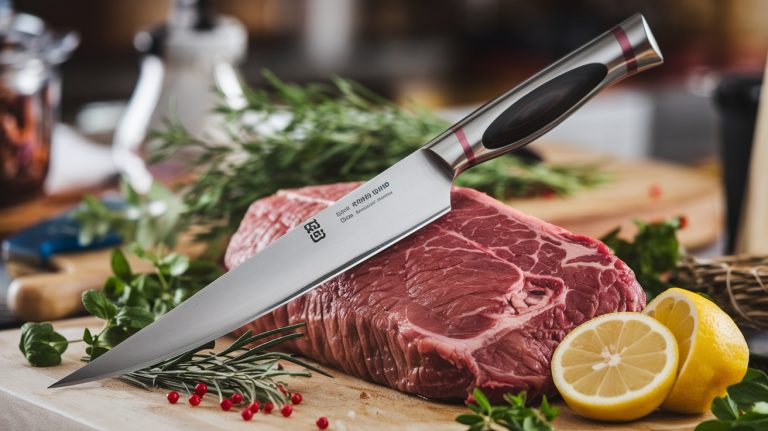
This careful selection sets the foundation for a perfectly slow-roasted prime rib with balanced juiciness and texture. Consider using a well-balanced, ergonomic knife with good edge retention when trimming excess fat to maintain precision and reduce hand fatigue, such as a full-tang vegetable cleaver.
Season and Prepare Your Prime Rib for Roasting
Seasoning and preparing your prime rib properly guarantees a flavorful crust and evenly cooked interior.
Start by patting the roast dry, then season generously with kosher salt and freshly ground black pepper, covering all sides.
For enhanced flavor, add garlic, rosemary, or mustard powder if you like.
Place the roast bone-side down on a roasting rack inside a pan to promote even heat circulation.
Ideally, refrigerate the uncovered roast overnight or up to 48 hours to dry the surface, which improves browning.
Before roasting, bring the meat to room temperature for about 2–3 hours to ensure even cooking.
This careful prep sets the stage for a tender, juicy prime rib with a perfect crust once roasted. Hanger steak is a flavorful, tender cut that comes from the diaphragm and is prized for its beefy flavor, though it requires trimming of a central sinew before cooking.
How to Slow Roast Prime Rib: Step-by-Step Process?
Set your oven to a low temperature between 185°F and 250°F to guarantee the prime rib cooks evenly and gently.
Place the roast on a rack in a roasting pan, allowing hot air to circulate. Season generously and insert the roast bone-side down or fat-cap up.
Slow roast for several hours depending on size and temperature.
| Step | Emotion | Tip |
|---|---|---|
| Preheat Oven | Anticipation | Low and slow for tenderness |
| Place Roast | Confidence | Use a rack for even cooking |
| Roast Slowly | Patience | Avoid rushing the process |
| Rest & Finish | Satisfaction | Juices redistribute, crust forms |
This method locks in flavor and texture, making each bite memorable and juicy.
Allow the roast to rest for 10 minutes after cooking to let the juices redistribute and achieve optimal internal temperature.
Use a Thermometer to Monitor Prime Rib Doneness
When it comes to cooking prime rib, an instant-read thermometer is your best friend. Just make sure to stick it in the thickest part of the meat, steering clear of any bone for the most accurate reading.
Now, if you’re aiming for that perfect doneness, keep an eye on those temperatures! For rare, you’re looking at around 115–120°F, while medium-rare is in the 120–130°F range. Hitting those precise numbers will guarantee your prime rib turns out just right every time.
Plus, using a thermometer helps you avoid overcooking. It also gives you the confidence to time that high-heat crust finish just right! So, keep that thermometer handy, and you’ll be golden. A high-quality thermometer with accurate ±1.8°F readings and durable probes ensures reliable results throughout long cooks.
Importance Of Internal Temperature
Although oven times provide a general guideline, relying on internal temperature is vital to achieve perfect prime rib doneness. Oven clocks can’t account for variations in roast size, shape, or oven hotspots.
Using an instant-read thermometer lets you monitor the internal temperature precisely, preventing overcooking or undercooking. Remember, carryover cooking will raise the temperature slightly after you remove the roast.
Keeping the roast at a safe temperature while resting helps prevent bacterial growth and preserve juiciness; use methods like tenting with foil or a warm oven to maintain safe temperatures.
| Doneness Level | Target Internal Temperature (°F) |
|---|---|
| Rare | 115–120 |
| Medium-Rare | 120–130 |
| Medium | 132–135 |
Tracking these temperatures guarantees your slow-roasted prime rib reaches your preferred doneness consistently. This ensures your roast is juicy and flavorful every time.
Thermometer Placement Tips
When monitoring prime rib doneness, placing the thermometer correctly is essential for an accurate reading.
Insert the probe into the thickest part of the roast’s center, avoiding bones, fat caps, or air pockets, as these can skew temperature readings.
Aim the probe horizontally, so it reaches deep into the meat’s core, not near the surface where external heat can mislead you.
If your roast is bone-in, position the thermometer between the bones but not touching them, since bones conduct heat differently.
Check the temperature after the roast has been cooking for at least half the estimated time to avoid repeated openings that drop the oven temperature.
Using an instant-read or leave-in digital thermometer with a probe guarantees continuous, reliable monitoring throughout the slow-roasting process.
Ensure the thermometer is not affected by air circulation issues that can cause uneven readings and equipment problems.
Target Doneness Temperatures
Since internal temperature directly determines prime rib doneness, you need to monitor it closely with a reliable thermometer. Relying on time alone won’t guarantee perfect results because oven variations and roast size affect cooking speed.
Aim for these target temperatures in the thickest part of the meat, away from bone:
- Rare: pull at 115–120°F; serve around 125°F after resting
- Medium-rare: pull at 120–125°F; finish near 128–130°F
- Medium: pull at 132–135°F before resting
Remember carryover cooking raises the internal temperature 5–10°F after removal.
Use an instant-read thermometer for accuracy and check multiple spots if needed. Monitoring internal temperature makes certain you hit your preferred doneness precisely, avoiding overcooking or undercooking your prime rib. For food-safety and quality, verify the center reaches 165°F when reheating leftovers to ensure safe serving temperatures.
Rest Your Prime Rib Before the Final Sear
Allowing your prime rib to rest before the final sear is a crucial step that guarantees even heat distribution and peak juice retention.
After the slow roast, remove the meat from the oven and let it sit uncovered or lightly tented with foil for 15 to 45 minutes.
This resting period lets internal juices redistribute uniformly, preventing them from spilling out during the sear.
It also stabilizes the roast’s internal temperature, minimizing uneven cooking during the high-heat finish.
Use an instant-read thermometer to confirm the roast’s temperature has plateaued or slightly cooled before proceeding.
Skipping this rest risks juice loss and uneven heat, compromising tenderness and flavor.
Proper resting guarantees your prime rib will remain juicy and cook evenly during the final sear, setting the stage for a perfect crust.
Finish Slow-Roasted Prime Rib With a High-Heat Sear
To really elevate your slow-roasted prime rib, you’ll want to finish it off with a high-heat sear. This step is key for getting that beautifully browned, flavorful crust while keeping the inside perfectly medium-rare.
Timing is everything here! You’re looking at about 5 to 15 minutes in an oven set to around 500°F. This ensures the surface crisps up nicely while the meat stays juicy and tender.
And let me tell you, that final blast of heat? It’s what locks in all those delicious juices and gives you the rich texture that makes an exceptional prime rib unforgettable. So don’t skip this step—it’s totally worth it! A dry surface and a thin coating of oil can significantly improve crust formation when searing, since the Maillard reaction happens best on dry, oiled meat.
Benefits of High Heat
Though slow roasting guarantees an evenly cooked, tender prime rib, finishing with a high-heat sear is essential. This develops a flavorful, deeply browned crust that contrasts beautifully with the juicy interior.
This final blast of heat activates the Maillard reaction, enhancing taste and texture. When you apply high heat, you:
- Create a savory crust that locks in juices, preventing dryness.
- Develop complex, caramelized flavors that elevate the roast.
- Add a pleasing textural contrast between the crust and tender meat.
- Visually enhance the roast with a rich, appetizing color.
This technique sharpens the sensory appeal of your dish, making every bite memorable. Without this step, the prime rib might lack the distinct flavor and mouthfeel that set a perfect roast apart. Adding hardwood smoke during an earlier low-and-slow phase can further deepen the savory profile by infusing complementary smoky flavors.
Timing the Searing Process
The perfect sear depends on timing that balances the intensity of the high heat with the internal temperature of your slow-roasted prime rib.
Pull the roast once it reaches about 120–125°F for medium-rare; this guarantees the center won’t overcook during the searing phase.
Preheat your oven or pan to 500°F to achieve that ideal crust quickly.
Sear the roast for 5 to 15 minutes, monitoring closely to avoid burning.
This brief, intense heat caramelizes the surface, locking in flavors while preserving the tender interior.
After searing, rest the meat for 15 to 30 minutes to allow juices to redistribute and stabilize temperature.
Proper timing here prevents dry edges and creates the perfect contrast between the juicy center and the crispy crust.
For food safety and optimal doneness, verify the internal temperature with an instant-read thermometer after resting.
Serve and Carve Slow-Roasted Prime Rib
Begin carving your slow-roasted prime rib only after it has rested sufficiently to allow the juices to redistribute, ensuring a moist and flavorful slice.
Carve your prime rib only after resting to keep each slice juicy and full of flavor.
Use a sharp carving knife and slice against the grain for tender, easy-to-chew pieces. Position the roast securely on a cutting board with a groove to catch juices.
To serve and carve effectively, remove any twine and place the roast fat-side up for even slicing.
Cut uniform slices about ½ inch thick to balance tenderness and presentation. Use a meat fork to steady the roast while slicing precisely.
Serve immediately, pairing with au jus or horseradish sauce to enhance flavor. This approach preserves the juiciness and showcases the prime rib’s rich texture beautifully.
Common Slow-Roast Prime Rib Mistakes to Avoid
When slow-roasting prime rib, you’ll want to avoid common pitfalls that can compromise texture, flavor, and overall success.
First, don’t skip seasoning or under-season; salt and pepper are essential for flavor and crust development.
Avoid cooking at too high a temperature initially, as it risks uneven doneness.
Rely on internal temperature, not just time, to pull the roast at ideal doneness—aim for 120–125°F for medium-rare before resting.
Don’t neglect resting; it stabilizes juices and ensures even temperature distribution.
Also, avoid placing the roast directly on the pan; use a rack to promote air circulation.
Finally, don’t omit the high-heat finish; it’s critical for forming a flavorful, crisp crust without overcooking the interior.
These details guarantee your prime rib turns out perfectly every time.
Frequently Asked Questions
Can I Slow Roast Prime Rib Without a Roasting Rack?
Yes, you can slow roast prime rib without a roasting rack, but it’s not ideal.
Without a rack, the roast sits directly on the pan, which limits air circulation and can cause uneven cooking or a soggy bottom crust.
To compensate, you might elevate the meat slightly using vegetables like carrots or onions.
Alternatively, you can create a makeshift rack with foil. This helps promote even heat flow and better browning during the slow roast.
How Long Can Cooked Prime Rib Be Safely Stored?
Back in the days of telegrams, you’d want to store cooked prime rib in the fridge within two hours of cooking.
You can safely keep it refrigerated for 3 to 4 days if you wrap it tightly or store it in an airtight container.
For longer storage, freeze it, and it’ll last 2 to 3 months without losing much quality.
Always reheat it thoroughly to at least 165°F before eating.
What Side Dishes Pair Best With Slow-Roasted Prime Rib?
You’ll want classic sides that complement prime rib’s rich flavor. Creamy mashed potatoes, roasted garlic, or horseradish mashed potatoes add smooth, savory balance.
Roasted or steamed asparagus, green beans, or Brussels sprouts bring freshness and crunch. Yorkshire pudding or crusty dinner rolls soak up juices perfectly.
A simple salad with vinaigrette cuts through the richness. These choices balance texture and flavor, enhancing your prime rib without overpowering it.
Is It Necessary to Bring Prime Rib to Room Temperature?
Do you really have to bring prime rib to room temperature before roasting?
While it’s not absolutely necessary, letting it sit out for 2–3 hours helps the meat cook more evenly.
If you roast it straight from the fridge, the center might stay underdone while the outside overcooks.
Can Slow-Roasted Prime Rib Be Frozen After Cooking?
Yes, you can freeze slow-roasted prime rib after cooking.
Make sure to cool it completely, then wrap it tightly in plastic wrap and aluminum foil or use an airtight container to prevent freezer burn.
For best quality, freeze within two hours of cooking.
When ready, thaw it slowly in the refrigerator for 24–48 hours before reheating gently to preserve tenderness and juiciness without overcooking the meat.
Slow-Roasted Prime Rib: From Seasoning to the Perfect Sear
Mastering slow-roasted prime rib not only elevates your cooking but also taps into a timeless tradition. Did you know the USDA recommends slow roasting for prime cuts to keep moisture and tenderness?
By choosing the right cut, seasoning thoughtfully, and monitoring with a thermometer, you guarantee perfect doneness every time. Resting before the final sear locks in juices, delivering that flawless crust and melt-in-your-mouth texture.
Follow these steps, and your prime rib will impress every time.