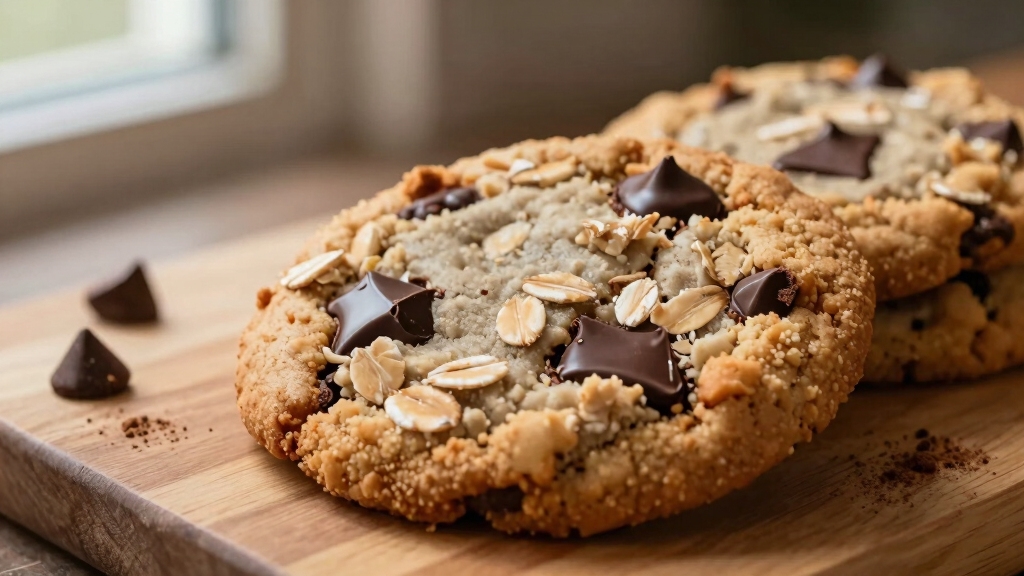
Chocolate Chip Protein Cookie Recipe: Easy, Soft & Chewy
You can make quick chocolate-chip protein cookies in 20–30 minutes that yield 8 large or 12 small treats by swapping whey, egg-white, or pea protein.
Use almond or a mix of almond and coconut flour to match your diet. Mix wets first, fold in dry, scoop (1.5–2 tbsp small, 3–4 tbsp large), flatten to 1/2″, and bake at 350°F (convection ok) for 10–15 minutes until edges set.
Keep them chilled or frozen; follow below for swaps, macros and fixes.
Key Takeaways
- Use a high-quality protein powder (whey or pea) and hydrate with wet ingredients to avoid dry, gritty cookies.
- Measure dough by weight or use a 1.5–2 tbsp scoop for small or 3–4 tbsp for large, flatten to 1/2″ thick.
- Preheat oven to 350°F (177°C), bake small cookies 10–12 minutes or large 12–15 minutes until edges set and centers slightly soft.
- Balance texture by adding nut butter or an extra egg when increasing protein powder; chill dough 15–30 minutes if spreading.
- Calculate per-cookie macros by weighing total batter and dividing; store in BPA-free containers or freeze for meal prep.
Chocolate Chip Protein Cookie Recipe Table
| Main Term | Details (Quick Reference Guide) |
|---|---|
| Recipe Name | Chocolate Chip Protein Cookie Recipe |
| Yield | 12 small cookies or 8 large cookies |
| Total Time | 20–30 minutes |
| Oven Temperature | 350°F (177°C), convection optional |
| Bake Time | Small: 10–12 minsLarge: 12–15 mins |
| Scoop Size | Small: 1.5–2 tbspLarge: 3–4 tbsp |
| Dough Thickness | Flatten to ½ inch thick |
| Protein Options | Whey (tender)Egg-white (light & dry)Pea (dense, dairy-free)Nut butter (chewy, higher calories) |
| Flour Options | Almond flour (moist, gluten-free)Coconut flour (absorbs more liquid)Oats (balanced texture) |
| Sweetener Options | Maple syrup, stevia, erythritol, sugar-free chips |
| Texture Fixes | Too dry → Add milk or egg whiteToo wet → Add almond flour/protein powderToo crumbly → Add nut butter |
| Storage (Fridge) | 10–14 days in airtight container |
| Storage (Freezer) | Up to 3 months (portion & label) |
| Per Cookie Macros (Avg.) | Calories: 95–246Protein: 5–15gCarbs: 5–19g (2g net possible)Fat: 6–17g |
| Diet Variations | Gluten-free, Dairy-free, Low-sugar, High-fiber |
| Best For | Post-workout snack, meal prep, high-protein dessert |
Chocolate Chip Protein Cookies : Quick Recipe Card (Yield & Time)

Yield: 12 small or 8 large cookies. Total time is about 20–30 minutes. Preheat to 350°F, line a sheet, and mix wet ingredients first. Then fold in dry components and chocolate chips.
Scoop evenly—use a tablespoon for small, two for large—and flatten slightly so centers bake through in 10–15 minutes. Let cookies cool to set texture and prevent crumbling.
This approach mirrors tested methods that optimize chewiness and even cooking while minimizing trial-and-error. Plan batches based on protein goals and snack frequency: 12 small cookies stretch further; 8 large suit higher-calorie needs.
Store in an airtight container up to two weeks or freeze portions for up to three months to preserve freshness and nutrient consistency. Consider using a neutral-flavored protein powder to help reach your protein targets without altering the cookie flavor.
Ingredients, Protein Options & Substitutes
When you pick ingredients for these chocolate chip protein cookies, prioritize a protein source that matches your dietary needs and texture goals.
Whey and egg-white powders give a light, tender crumb and higher bioavailable protein. Pea and other plant proteins work well for dairy-free diets but may need extra binder (egg or flax) to prevent dryness. Nut butters add both fat and chewiness while boosting protein and calories.
Choose sweeteners and flours based on glycemic goals and texture. Almond flour keeps them gluten-free and moist, while coconut flour absorbs more liquid. Match chocolate chips (dark or sugar-free) to sugar targets.
Use the table to compare trade-offs quickly.
| Protein Type | Texture Impact | Best Use Case |
|---|---|---|
| Whey | Tender | High-protein, low-fat |
| Pea | Dense | Dairy-free |
| Nut butter | Chewy, rich | Higher calories, satiating |
For added nutrition and to help reach higher protein goals, consider combining powders with nut butters or seeds to increase complete protein and healthy fats.
Tools, Oven Settings & Prep Steps
Before you heat the oven, gather the right tools so your cookie workflow stays smooth and efficient. You’ll want reliable gear: a digital scale for consistent portions, a silicone spatula and mixing bowl for thorough blending, and a baking sheet with parchment to prevent sticking. Preheat to 350°F (177°C).
Many tested protein-cookie recipes bake best at this temperature to set edges without overbrowning.
- Measure ingredients precisely; protein powder varies in density.
- Line pans and keep a cooling rack ready to stop carryover cooking.
- Use an oven thermometer to verify actual temperature.
These steps cut variability and improve repeatability. Your cookies will match target texture and nutrition from batch to batch. For storing leftovers, choose an airtight, BPA-free container like a stackable ice cream container to help maintain freshness and prevent freezer burn.
Mixing & Forming the Cookies (Step‑by‑Step)
Alright, let’s get started!
First things first: you want to mix your wet ingredients really well before adding any of the dry stuff. This way, the protein powder and flours can hydrate evenly, and you won’t end up with those annoying gritty pockets.
Once your wet ingredients are nicely combined, it’s time to fold in the dry mix with a spatula. Just keep mixing until everything is just incorporated—no need to overdo it!
Then, stir in those chocolate chips. This little step helps prevent overmixing, which keeps your cookies nice and tender.
Now, scoop out uniform portions of the dough. Don’t forget to gently flatten each mound to about 1/2 inch. This helps with even baking and gives you that chewy texture we all love.
Also, lightly spritzing the dough with a bit of oil can help coatings and mix-ins stick better for even distribution.
Happy baking!
Wet-To-Dry Incorporation
Although you’ve already combined the wet ingredients, you’ll get the best texture by adding the dry mix in stages and folding gently until just incorporated. This prevents overworking proteins and keeps the cookies tender.
Start by scraping down the bowl and splitting the dry mix into portions to control hydration and structure. Follow these evidence-based, practical steps to preserve protein integrity and avoid gummy crumbs:
- Add one-third of dry, fold until streaks vanish.
- Repeat with second third, assess dough—stop when uniform but slightly shaggy.
- Stir in final third and mix just until no dry pockets remain; finish with chocolate chips.
You’ll notice better crumb, even baking, and consistent protein distribution when you avoid vigorous mixing. For best results, let the dough rest briefly before baking to allow hydration and protein distribution to stabilize.
Shaping And Flattening
Scoop the dough into uniform portions using a cookie scoop or two spoons so each cookie bakes evenly. Aim for 1.5–2 tablespoons for smaller cookies or 3–4 tablespoons for larger ones.
Place portions on a parchment-lined sheet about 2 inches apart for small cookies or 3 inches for large. Roll each portion briefly between your palms if you want round tops.
Then press gently with the back of a wet or oiled spoon to flatten to about 1/2 inch thick. Protein-dense doughs benefit from a slight flatten because they don’t spread as much.
For chewier cookies, press slightly less; for crisper edges, flatten a touch more. Sprinkle extra mini chips on top for appearance.
Weigh or count portions to maintain consistent nutrition and baking time. A reliable technique for achieving even texture is to ensure your dough portions are cooked al dente-level firm before baking to prevent over-spread.
Baking Tips: Scoop Size, Time & Doneness
When you choose a scoop size, you’re deciding how many calories, protein grams, and baking minutes each cookie will have, so pick one and weigh the trade-offs. Use a 1.5–2 tablespoon scoop for bite-sized cookies or a 3–4 tablespoon scoop for larger, chewier cookies. Larger scoops need more time and a gentler bake.
- Preheat & time: 350°F is reliable. Small cookies bake 10–12 minutes; large, 12–15 minutes. Watch edges.
- Doneness cues: Edges should set and the center still look slightly soft. Carryover heat firms them off-sheet.
- Sheet management: Space dough 2 inches apart, use parchment, cool 5 minutes on the sheet, and finish on a rack.
These tips reflect standard protein-cookie practice for consistent results. Using a convection setting with even heat distribution can improve consistency for multiple batches when baking larger quantities, especially in ovens with adjustable rack positions.
Nutrition & Serving Sizes (Calories, Protein, Carbs, Fat)
You’ll definitely want to take a look at the nutrition information for each cookie. This way, you can see exactly how many calories, grams of protein, carbs, and fat you’re getting. Brands can vary quite a bit, ranging from around 95 to 246 calories and 5 to over 15 grams of protein per cookie.
If you decide to adjust the scoop size from 8 large cookies to 12 smaller ones, keep in mind that those numbers will change proportionally. So, it’s a good idea to plan your servings based on your specific goals.
Also, think about the macronutrient tradeoffs. For instance, adding more nut butter can increase the fat and calorie content, but it also boosts protein and helps you feel fuller.
On the other hand, using a higher-protein powder can ramp up your protein intake while keeping carbs to a minimum. So, consider what works best for you!
You can also pair a cookie with a portion-controlled serving of high-protein, low-calorie cereal like single-serve packs to help reach a balanced post-workout meal.
Per-Cookie Nutrition Breakdown
Clarity matters when you’re tracking macros, so let’s break down what one protein cookie typically delivers: depending on the recipe and serving size, a cookie can range from about 95 to 246 calories.
It usually provides 5–15 grams of protein, 5–19 grams of carbs (some recipes report just 2g net), and 6–17 grams of fat. Use brand samples to set expectations: Sophie’s Bakery and Devotion sit near the low-to-mid calorie range with ~7–10g protein.
Quest and Eat With Clarity hit higher calories and protein.
To assess your homemade batch, weigh total batter, divide by cookies, and calculate from ingredient labels.
Quick reference:
- Protein: 5–15g; adjust with powder or nut butter.
- Carbs: 5–19g; 2g net possible.
- Fat: 6–17g; mainly from nut butters.
For more consistent results, consider using protein powder that pairs well with your chosen flour and moisture sources to help prevent dry cookies and balance texture.
Serving Size Variations
Although portion size changes a cookie’s macros, you can reliably scale calories and protein by weight or count. Plan servings around your goals.
If you make eight large cookies, expect roughly 140 calories and higher protein per piece. Twelve smaller cookies drop to about 95 calories each, as shown in recipe variations.
Use a kitchen scale to portion dough (for example, 40–60 g per cookie) to predict calories and grams of protein based on your chosen protein powder and nut butter.
Track carbs and fat similarly. Ingredients like almond flour and peanut butter shift totals.
For meal prep, label containers with serving count and approximate macros. That way you’ll meet calorie or protein targets without guessing.
Wide-mouth jars are helpful for meal-prep storage and freezing because they allow easier filling and accommodate expansion when freezing, making them a practical option for preserving portions in the freezer; see wide mouth for details.
Macronutrient Tradeoffs
When you balance macros in protein cookie recipes, you trade off calories, protein, carbs, and fat in predictable ways. These adjustments affect texture, satiety, and nutrition goals.
You’ll choose ingredients to hit targets: more protein powder raises protein and can dry cookies. More nut butter increases fat and chewiness, while added oats or sugar raise carbs and calories.
Use serving-size adjustments to control per-cookie macros. Eight large cookies versus twelve small shifts calories and protein per piece.
- Increase protein powder to boost protein (e.g., 10–15g/cookie) but add egg or nut butter to prevent dryness.
- Swap almond flour for oats to lower carbs slightly and maintain structure.
- Use mini dark chips to cut sugars without losing flavor.
Track totals against your goals and adjust portion size.
Variations: Gluten‑Free, Dairy‑Free, Low‑Sugar, High‑Fiber
If you need to fit dietary restrictions, you can easily adapt the basic chocolate chip protein cookie template to be gluten-free, dairy-free, low-sugar, or high-fiber without sacrificing texture or protein content.
For gluten-free, swap all-purpose flour for almond or coconut flour and use certified gluten-free oats. Almond flour keeps moisture and adds protein.
For dairy-free, use plant-based protein powder (pea or egg-white is dairy-free), almond or peanut butter, and dairy-free chocolate chips or chopped dark chocolate.
To cut sugar, replace maple syrup with stevia or erythritol-based sweeteners and choose sugar-free chips. Expect minor textural tweaks.
For high-fiber, fold in oat bran, ground flaxseed, or extra oats to reach up to ~9g fiber per cookie while balancing wet ingredients to avoid dryness.
Troubleshooting, Storage & Shelf‑Life
Because protein powders and alternative flours absorb liquid differently, you’ll want to troubleshoot texture issues by adjusting wet or dry ingredients in small increments.
Because protein powders and alternative flours absorb liquids differently, adjust wet or dry ingredients gradually to fix texture.
Add a tablespoon of milk or an extra egg white if the dough is too dry. Sprinkle in a teaspoon of almond flour or protein powder if it’s too wet. Test-bake one cookie to confirm.
For common faults, try these steps:
- If cookies spread too much, chill the dough for 15–30 minutes and reduce added oil or sweetener slightly.
- If they’re crumbly, add a beaten egg white or 1–2 tsp nut butter for cohesion.
- If underbaked centers occur, lower the oven temp by 10°F and bake 1–3 minutes longer.
Store cooled cookies in an airtight container: fresh for 10–14 days refrigerated, up to 3 months frozen. Thaw at room temperature.
Frequently Asked Questions
Can I Make These Cookies Ahead for Events or Parties?
Yes, you can make them ahead. Bake, cool completely, then store airtight at room temperature for up to 2 weeks or freeze for up to 3 months.
Thaw in the fridge or at room temperature, then warm briefly for a fresh texture.
For events, bake a day or two early for the best flavor.
Freeze extras and defrost as needed. Label batches with the date and reheating instructions to stay organized.
Are These Cookies Safe for People With Nut Allergies?
Not necessarily. They often contain nut butters or almond or coconut flours, so they’re unsafe for people with nut allergies unless reformulated.
You can make them nut-free by using seed butter such as sunflower or pumpkin, and oat or all-purpose flour instead of almond or coconut.
Confirm that protein powder and chocolate chips are processed nut-free. Always check labels for cross-contamination and clearly label batches.
If the allergy is severe, avoid shared prep surfaces and utensils to prevent exposure.
Can I Freeze Baked Cookies With Frosting or Toppings?
Yes, you can freeze baked cookies with frosting or toppings. Think of your cookies as travelers boarding a protective snow globe: wrap them well to keep decorations intact.
Chill frosted cookies first, then freeze on a tray until firm. Stack with parchment between layers and seal airtight.
Label and freeze for up to three months. Thaw in the fridge or at room temp to preserve texture and safety.
How Do Texture and Taste Change With Different Protein Powders?
They change noticeably: whey gives lighter, cakier cookies with a milky flavor. Egg-white yields a drier, more crumbly texture and neutral taste.
Pea or plant blends make denser, grainier cookies with earthy notes. Higher-fat blends or added nut butter produce chewier, richer cookies.
You’ll need to tweak liquids, eggs, or nut butter to balance dryness or density. Consider sweetener or vanilla to mask any bitter or beany aftertastes.
Can I Scale Recipe for Commercial Sale or Wholesale Packaging?
Think big; yes, you can scale for wholesale. You’ll need consistent ingredient sourcing, batch-tested recipes, and shelf-life/stability data (2 weeks fresh, 3 months frozen as a baseline).
Validate texture with pilot runs using commercial mixers, adjust baking times, and confirm nutrition labels per batch.
Make certain packaging meets food safety, labeling, and allergen laws. Partner with a co-packer if you’re not set up for high-volume production.
Protein-Packed Perfection Made Easy
You’ve got a dependable chocolate-chip protein cookie formula that’s practical and flexible. By chance, it fits whatever goal you’ve got: post-workout, snack time, or a sweet treat with your morning coffee.
Use the evidence-backed swaps (protein type, flour, sweetener) we covered, and you’ll still hit texture and macros. Store them cool, adjust scoop size for portions, and tweak bake time for doneness.
Enjoy the cookies and the little coincidences that make baking feel effortless.