Best Way to Sharpen a Knife: Common Mistakes to Avoid
You sharpen your knife best by matching your method to the blade’s hardness and your skill level.
Use honing steels for softer blades to realign edges and bench stones for harder blades, keeping a consistent 15–20° angle.
Start coarse to fix damage, then refine with medium and fine grits, switching when a burr forms.
Test sharpness by slicing paper cleanly without snagging. For quick touch-ups, try sandpaper or electric sharpeners.
Discover more techniques and tips to keep your knives razor-sharp.
Key Takeaways
- Use a bench stone with coarse to fine grits, maintaining a consistent 15–20° angle for precise, sharp edges.
- Employ sharpening systems or guided angle tools for consistent results, especially if inexperienced with freehand sharpening.
- Hone regularly using a honing steel at 15–20° to realign the blade edge and extend sharpness between sharpenings.
- Choose sharpening methods based on blade hardness and convenience, such as electric sharpeners for ease or whetstones for control.
- Test sharpness by slicing paper cleanly without snagging to confirm a properly sharpened knife edge.
How to Know When Your Knife Needs Sharpening?

You’ll often notice your knife needs sharpening when it struggles to slice cleanly through food or slips off the surface instead of biting in.
If you find yourself applying extra force or the blade tears rather than cuts, it’s a clear sign the edge has dulled.
Another practical test is slicing a sheet of paper. If the knife snags or fails to slice smoothly, it’s time to sharpen.
Visually inspect the edge under good light; a shiny, rounded edge indicates wear, while a sharp blade has a consistent, matte finish.
Dull knives not only reduce efficiency but increase the risk of accidents.
Regularly evaluating your knife’s performance helps you maintain precision and safety in the kitchen, ensuring your blade is always ready for clean, effortless cuts.
For curved blades, consider using a round-edged stone designed to maintain proper contact with the edge while sharpening.
Sharpening Methods for Different Knife Types
Regularly checking your knife’s performance helps you know when it needs sharpening. The method you choose depends on the type of knife you have.
Regularly assessing your knife’s sharpness ensures timely maintenance tailored to your blade type.
For soft blades (52-56 HRC) like typical chef’s or butcher’s knives, honing steels maintain the edge by realigning it without removing much material.
Harder blades above 56 HRC require more intensive methods. Bench stones offer precise edge formation, ideal for high-quality knives.
You can start coarse and progress to fine grits for a lasting sharp edge.
Sharpening systems provide a guided angle, making them easier for beginners while ensuring consistent results.
Alternative methods like electric sharpeners remove more material but offer convenience.
Always match your sharpening method to the blade’s hardness and your skill level for the best outcome.
Using a suitable honing steel, such as a 9-inch model appropriate to your knife length, helps maintain edge alignment between sharpenings.
How to Use a Honing Steel to Maintain Soft Blades?
When you’re using a honing steel on soft blades, it’s important to hold the knife at about a 15-20° angle to the steel. This angle really helps with aligning the edge effectively.
As you work, remember to alternate strokes on each side of the blade. This technique helps create or straighten a fine burr without taking off too much material.
Oh, and keep in mind that this burr can fold over pretty quickly while you’re cutting. That’s why frequent honing is key to keeping your knife sharp!
Regular honing before and after use helps maintain sharpness and extends the lifespan of your knives.
Correct Angle Technique
Mastering the correct angle technique with a honing steel is essential for maintaining the sharpness of soft blades, typically rated between 52 and 56 HRC.
To use the honing steel effectively, you need to guide the blade at a consistent angle of 15 to 20 degrees. This angle helps realign the edge without removing significant material, preserving the blade’s integrity.
Remember these key points:
Hold the honing steel vertically and place the knife at 15-20° against it. Alternate strokes on each side of the blade, maintaining the angle throughout. Use light pressure and smooth, controlled motions to straighten the edge.
This technique keeps your soft blade honed, extending cutting performance between sharpenings. For safe honing, always keep the steel secured on a stable surface and use slow, controlled movements.
Burr Formation and Care
Creating and managing the burr is key to maintaining a soft blade’s sharpness with a honing steel.
You’ll hold the blade at a 15-20° angle, sliding it alternately along the steel to create or straighten a fine burr.
This burr is a tiny fold of metal that quickly wears off during use. Frequent honing keeps your edge keen without removing much material.
| Step | Action |
|---|---|
| 1. Position blade | Hold at 15-20° angle |
| 2. Stroke | Slide blade along steel |
| 3. Alternate sides | Switch sides each stroke |
| 4. Repeat | Hone frequently to maintain edge |
Use light, consistent pressure to avoid damaging the edge.
Honing steel works best on softer blades (52-56 HRC), preserving sharpness efficiently.
Longer rods like 12-inch steels can provide better coverage for larger knives and make maintaining the burr easier.
Sharpening Knives With Bench Stones
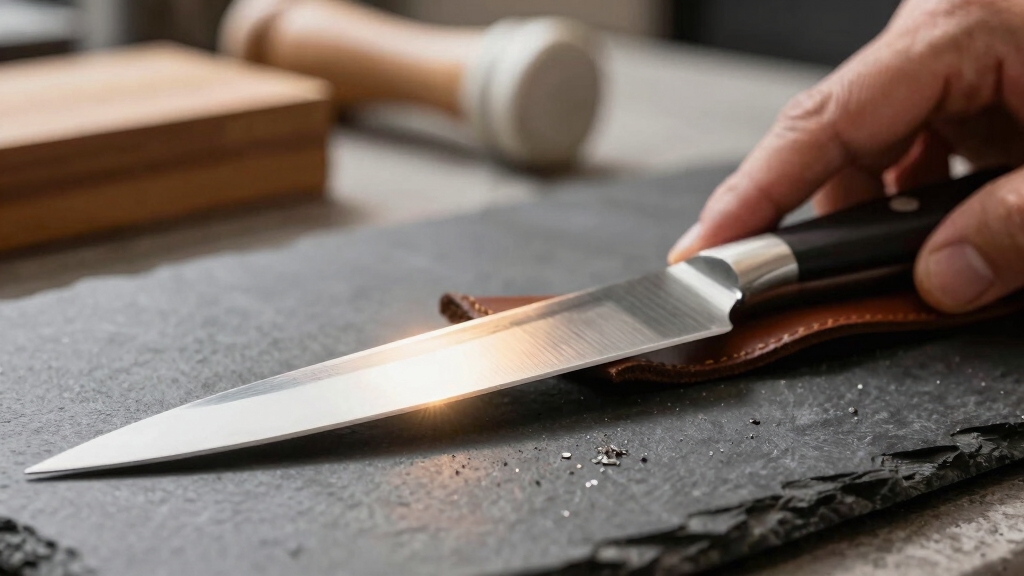
Start sharpening your knife by selecting the appropriate bench stone grit, beginning with a coarse stone to repair damage and reshape the edge.
Use water stones or diamond plates for best results, and keep the stone wet if necessary to prevent clogging.
Maintain a consistent angle, typically around 15-20°, throughout the process.
After raising a burr on one side, switch to the other, alternating strokes evenly.
Progress from coarse to medium and fine grits for a smooth, long-lasting edge.
Apply heavier pressure on coarse stones, then lighten as you move to finer stones.
Test sharpness regularly by slicing thin paper to ensure edge refinement.
Bench stones require practice but deliver precise, geometrically correct edges unmatched by other methods.
Regular maintenance and proper cleaning before sharpening help ensure effective and safe results, and using oil or water as a lubricant can reduce friction during the process.
Sharpening Systems for an Easy Perfect Edge
Although sharpening with bench stones offers excellent results, sharpening systems provide an easier way to achieve a consistent, perfect edge.
These systems hold your knife firmly in place while you move an abrasive tool over the edge at a fixed angle, ensuring uniform sharpening without the guesswork.
They work similarly to bench stones but simplify angle control, making it easier to maintain precision, especially if you’re new to knife sharpening.
Most systems guide angles above 25°, which suits many kitchen knives.
To get the best edge, progress through finer abrasives, alternating strokes on each side until scratches vanish.
While they may not offer the full customization of bench stones, sharpening systems deliver reliable, repeatable edges quickly and with less practice.
This makes them a practical choice for consistent maintenance.
For those seeking longevity and low maintenance, consider systems that incorporate diamond plates for aggressive, durable sharpening.
How to Choose and Switch Sharpening Grits?
When you’re ready to sharpen your blade, you’ll want to kick things off with a coarse grit. This is perfect for tackling any damage or dullness. Think of it as the first step to getting your edge back in shape.
Once you’ve got that initial sharpening done, it’s time to move on to medium grits. These are great for general sharpening and will help refine the edge further.
Now, here’s a little tip: as you sharpen, keep an eye out for a burr forming on both sides of the blade. That’s your cue to switch it up and grab those finer grits. This is where the magic happens—polishing and perfecting your edge for a sharp, lasting finish.
Remember, knowing when to switch grits is key. It helps with efficient material removal and ensures your blade stays sharp for longer!
Also, if you primarily want to maintain the edge rather than remove metal, consider using a honing steel regularly to realign the blade before you decide to sharpen.
—
Grit Levels Explained
Mastering grit levels is essential for effective knife sharpening, as choosing and switching between grits determines how quickly and precisely you restore your blade’s edge.
Coarse grits (#80-400) remove chips and reshape dull edges by removing more material fast.
Medium grits (#800-2000) refine the edge, ideal for most kitchen knives, balancing material removal with sharpness.
Fine grits (#6000-10000) polish the blade, enhancing sharpness and edge longevity.
When you sharpen, remember to start with heavy pressure on coarse grits to reshape the edge.
Lighten pressure as you move to finer grits to avoid over-grinding.
Raise a burr on both sides before switching to the next finer grit for best results.
This progression guarantees a durable, razor-sharp edge every time.
For curved blades, using a round-edged stone helps maintain consistent contact and preserves the blade’s curvature.
When To Switch
Since each grit level serves a specific purpose in sharpening, knowing when to switch between them guarantees efficient edge restoration without wasting time or removing excess material.
Start with a coarse grit (#80-400) if your knife has chips, damage, or is very dull. Use heavy pressure to reshape the edge and raise a burr on both sides.
Once the burr forms consistently along the edge, switch to medium grit (#800-2000) to sharpen and refine the blade, reducing pressure as you progress.
Finally, move to fine grit (#6000-10000) to polish the edge, enhance sharpness, and increase longevity.
Always alternate sides evenly, watch for burr formation and disappearance, and lighten your strokes with each finer grit to avoid over-sharpening.
After sharpening, clean and maintain your whetstone using proper methods to remove metal debris and preserve its surface; regular cleaning with water and occasional flattening helps ensure lasting performance.
Maintaining a Consistent Sharpening Angle
Consistently maintaining the sharpening angle is essential for achieving a sharp, durable edge on your knife. If your angle varies, you risk uneven wear or a dull, weak edge. To keep your angle steady, use simple guides like two pennies under the blade spine or a sharpening system that fixes the angle for you.
Keep these points in mind:
Aim for a 17.5° to 20° angle per side for most kitchen knives. Use a forward stroke at about a 6° tilt, alternating sides evenly. Lighten pressure as you progress from coarse to finer grits to refine the edge.
Alternative Methods for Quick Knife Touch-Ups
Maintaining a steady sharpening angle helps build a reliable edge. But sometimes you need faster ways to keep your knife sharp between full sessions.
Alternative methods provide quick touch-ups without the time commitment of full sharpening. You can use sandpaper on a mousepad for a budget-friendly option or an electric sharpener for ease and speed.
Rolling sharpeners with magnetic angle guides offer consistent results. Machines like Tormek handle flat sides efficiently.
| Method | Key Benefit |
|---|---|
| Sandpaper + Mousepad | Affordable, customizable |
| Electric Sharpener | Fast, beginner-friendly |
| Rolling Sharpener | Consistent angle control |
| Tormek Machine | Precise flat side grind |
Choose based on convenience, blade type, and desired sharpness level.
Tips to Test and Maintain Sharpness After Sharpening
After sharpening your knife, you’ll want to verify its edge to confirm it performs at its best.
Testing sharpness guarantees the effort you put into sharpening translates into practical cutting power. You should also maintain that sharp edge regularly to extend its life and avoid frequent major sharpening.
Here are key tips to test and maintain sharpness:
Paper test: Slice through a sheet of paper cleanly without snagging to confirm sharpness.
Honing: Use a honing steel frequently to realign the edge and remove minor burrs.
Storage: Store knives properly in a block or on a magnetic strip to prevent dulling from contact.
Following these steps keeps your knife ready for precise, efficient cutting every time.
Frequently Asked Questions
How Often Should I Completely Sharpen My Knife Versus Honing It?
You should completely sharpen your knife only when honing no longer restores its edge. This usually occurs after several weeks or months of regular use.
Honing realigns the edge and can be done frequently, even before each use, especially with softer blades.
When you notice the knife struggles to cut smoothly or fails a paper test, it’s time for full sharpening to remove material and reshape the edge for lasting sharpness.
Can Sharpening Damage My Knife’s Blade or Reduce Its Lifespan?
Did you know that frequent sharpening can remove microns of metal each time? Yes, sharpening can damage your blade and shorten its lifespan if you overdo it because it removes material.
To protect your knife, sharpen only when necessary and rely on honing steel regularly to straighten the edge. Use proper techniques and grit progression to minimize wear.
This way, you keep your blade sharp without sacrificing durability.
What Is the Difference Between Sharpening and Honing?
Sharpening actually removes material to create a new edge. It fixes dullness or damage by grinding away metal.
Honing, on the other hand, doesn’t remove much. It realigns the existing edge by straightening the blade’s microscopic bends.
You’ll hone frequently to maintain sharpness between sharpenings, especially on softer blades.
How Do I Store Sharpened Knives to Maintain Edge Quality?
Think of your sharpened knife as a delicate flower. Store it carefully to keep its beauty intact.
Use a magnetic strip, knife block, or blade guards to prevent dulling from contact with hard surfaces.
Avoid tossing knives loosely in drawers where edges can chip.
Keep blades dry and away from moisture to prevent corrosion.
Are There Specific Knife Steels That Don’T Require Sharpening?
You won’t find knife steels that never require sharpening. Some ultra-hard steels hold an edge longer but still dull over time.
Steels above 56 HRC resist wear better but need specialized sharpening tools. If you want minimal sharpening, choose high-hardness steels like VG-10 or S30V, but expect occasional maintenance.
Even ceramic blades, which keep edges longer, eventually need professional sharpening or replacement. Regular honing helps maintain sharpness between sessions.
Keep Your Knives Razor-Sharp with Consistent Maintenance
Now that you’ve mastered these sharpening techniques, keeping your knives razor-sharp will be a walk in the park.
Remember, regular maintenance with a honing steel and the right sharpening grit keeps your blades in top shape.
Stick to a consistent angle and test sharpness often. Don’t let your edge go dull and rusty. With these tips, you’ll always cut through tasks like a hot knife through butter.