How Long Does It Take for Fridge to Get Cold: Cooling Facts
You can expect your fridge to reach an ideal temperature between 37°F (3°C) and 40°F within 4 to 24 hours after setup.
Most models begin cooling in the first few hours, but full stabilization usually takes a full day.
Factors like room temperature, fridge type, and loading impact timing.
Avoid opening the door during this period to maintain temperature balance.
Your freezer should hit 0°F around the same time for peak operation.
More insights on cooling efficiency and setup follow.
Key Takeaways
- Refrigerators typically take 4 to 24 hours to reach the ideal temperature of around 37°F for the fridge compartment.
- Most models start cooling within the first few hours but require a full 24-hour stabilization before loading food.
- Avoid frequent temperature adjustments during the initial cooling period, as each change needs about 24 hours to stabilize.
- Cooling times vary by model, room temperature, humidity, and how much the fridge is loaded.
- Minimizing door openings during the first 24 hours helps maintain consistent cooling and speeds up temperature stabilization.
How Long Does a Fridge Take to Get Cold After Setup?

Typically, a refrigerator takes between 4 to 24 hours to reach its ideal cooling temperature after setup. You’ll notice most models start cooling within the first few hours, but full stabilization demands patience.
For example, Whirlpool and GE recommend allowing a full 24 hours before loading food to guarantee consistent temperature and optimal ice production. During this period, the unit’s thermostat adjusts to maintain approximately 37°F in the fridge compartment and 0°F in the freezer, meeting FDA safety standards.
Controls usually come preset at mid-level for normal operation. Avoid adjusting settings frequently during this phase, as changes require an additional 24 hours to stabilize. For best results, ensure the fridge has space around it for proper airflow and adequate ventilation to help it cool efficiently.
What Factors Affect Fridge Cooling Time?
While the average cooling time provides a general guideline, several specific factors directly influence how quickly your fridge reaches ideal temperature.
Understanding these variables helps you optimize performance and avoid premature loading or frequent door openings that delay cooling.
Key factors affecting cooling time include:
Refrigerator type and model efficiency: Top-freezer units generally cool faster than French door or counter-depth models.
Energy Star-rated appliances tend to reach target temperatures more rapidly due to advanced compressors and insulation.
Ambient room temperature and humidity: Higher temperatures and humidity levels increase thermal load, slowing the fridge’s heat extraction process.
Internal load and power supply: An empty fridge cools faster initially but stabilizes slower.
A partial load aids temperature maintenance.
Weak power outlets or extension cords reduce compressor efficiency, extending cooling duration.
Many users also consider water filtration needs—NSF/ANSI certification indicates effective contaminant removal and can be a factor when evaluating refrigerator features.
How Does Moving a Fridge Impact Cooling Startup?
If you move your fridge on its side or back, you must wait 2 to 4 hours before plugging it in to allow the refrigerant and compressor oil to settle properly. This precaution prevents compressor damage and guarantees the coolant circulates effectively.
When upright, the refrigerant and lubrication oil distribute evenly, enabling optimal heat exchange. If you skip this waiting period, the compressor may operate without proper lubrication, leading to increased wear or failure.
Additionally, moving the fridge disturbs internal components, potentially causing temporary delays in reaching target temperatures. Larger or more advanced models may require longer stabilization.
To optimize startup cooling, position the fridge upright immediately after moving, avoid plugging it in prematurely, and maintain recommended room temperature conditions. Following this procedure guarantees efficient compressor function and consistent cooling startup performance.
Also, before moving, be sure to measure refrigerator dimensions and assess clearances to plan a safe, unobstructed pathway.
What Are the Recommended Temperature Settings for Safe Cooling?
Consistently setting your refrigerator between 37°F and 40°F and your freezer at 0°F guarantees peak food safety and efficient cooling performance.
These precise temperatures inhibit bacterial growth and maintain ideal humidity, preserving food quality.
Avoid fluctuations by adjusting settings gradually and allowing 24 hours for stabilization after changes.
To make certain safe cooling, keep in mind:
The refrigerator should never exceed 40°F to prevent spoilage.
Freezer temperature at 0°F preserves long-term food integrity and ice production.
Utilize built-in temperature controls calibrated to maintain steady internal climate, avoiding overcooling or energy waste.
Adhering strictly to these parameters protects your food from contamination and supports the fridge’s efficient operation.
This ensures consistent performance and safety.
Bosch models often reach stable internal temperatures more quietly and efficiently due to their sensor-driven water and energy optimization.
How Can You Speed Up Your Fridge’s Cooling Process?
You know, if you want to speed up your fridge’s cooling process, one great tip is to load it up to about three-quarters full. This really helps stabilize the internal temperatures and makes everything work more efficiently.
Also, think about the room temperature! Keeping the area around your fridge cool and dry can actually reduce the workload on the compressor, which is a win-win.
Oh, and here’s another handy tip: try to minimize how often you open the fridge door, especially during the initial cooling phase. Each time you open it, warm air sneaks in, and that can really slow down the temperature stabilization. So, the less you open the door, the quicker it’ll cool down!
A black sink’s noise-dampening technology can make kitchen tasks quieter, which is helpful when you’re running appliances like refrigerators nearby.
Optimize Fridge Load
Optimize the fridge load by filling it about three-quarters full with food, water containers, or other goods to speed up the cooling process. A partially filled fridge stabilizes temperature faster because the stored items absorb and retain cold, reducing compressor cycling frequency.
Avoid overloading, which restricts airflow and impedes cooling efficiency.
To optimize load effectively, distribute items evenly to maintain consistent airflow across shelves. Use water-filled containers as thermal mass to enhance temperature stability.
Avoid placing warm or hot items inside to prevent temperature spikes. This balance leverages thermal inertia, allowing the compressor to operate efficiently and reach target temperatures faster.
Proper load management is vital during the initial 24-hour cooling period, ensuring uniform cooling and ideal energy use without compromising food safety. LG’s inverter Linear Compressor and multi-air flow systems can also help reduce power usage and stabilize temperatures.
Control Ambient Temperature
After managing the fridge load for efficient cooling, controlling the ambient temperature around your refrigerator plays a significant role in speeding up the process.
Make sure the room temperature stays within the manufacturer’s recommended range, ideally between 65°F and 75°F. High ambient temperatures increase the compressor workload, prolonging the cooling cycle.
Avoid placing the fridge near heat sources like ovens, direct sunlight, or heating vents, which elevate surrounding air temperature and reduce efficiency.
Maintain adequate ventilation by leaving at least a few inches of clearance around the fridge to allow heat dissipation from coils.
Excess humidity can also impair cooling performance by causing condensation around coils, so keep the environment dry if possible.
Consider models with advanced water filtration and smart features that can help optimize cooling performance and efficiency.
Minimize Door Openings
Frequently opening the refrigerator door disrupts the internal temperature balance, forcing the compressor to work harder and prolonging the cooling process. Each door opening introduces warm air, which increases the internal temperature and delays the unit from reaching its ideal 37°F.
To speed up cooling, minimize these interruptions, especially within the first 24 hours of operation when the fridge stabilizes.
Plan ahead by gathering everything you need before opening the door. Limit door openings to essential instances only during initial cooling. Avoid placing warm or hot items inside, which raises internal temperature. Overloading the appliance can impede airflow and slow cooling, so avoid placing too many items at once and ensure proper ventilation for the compressor air circulation.
Why Should You Avoid Opening the Fridge During Initial Cooling?
Because opening the fridge during its initial cooling phase disrupts the temperature stabilization, you should avoid doing so to guarantee efficient operation. Each time you open the door, warm air enters, causing the compressor to work harder and extend the time needed to reach peak temperatures. This compromises food safety and energy efficiency.
| Effect | Impact on Cooling Time | Technical Explanation |
|---|---|---|
| Warm air entry | Increases | Raises internal temperature |
| Compressor workload | Increases | More energy required to cool down |
| Temperature fluctuation | Frequent | Delays stable cooling |
| Energy consumption | Higher | Reduced efficiency |
| Food safety risk | Elevated | Delays reaching safe storage temps |
Avoid opening the door to ensure your fridge stabilizes quickly and operates efficiently. A quick assessment of doorway and clearance can help determine if moving the fridge for better airflow is necessary.
How Does Fridge Load Affect Cooling Time?
You know how when you first turn on an empty fridge, it cools down pretty quickly? That’s because there’s less stuff in there to chill.
But here’s the catch: once it’s empty, it can have a tough time keeping those temperatures stable.
So, what’s the best approach? Well, loading your fridge about three-quarters full with food or water containers really does the trick.
This way, you optimize the thermal mass, making it easier for the fridge to reach and maintain that ideal temperature of around 37°F.
But watch out! If you overfill it or keep opening the door too often, you might actually slow down the cooling process.
Those frequent temperature changes can really throw things off balance.
Using airtight, BPA-free containers can also help maintain consistent temperatures and keep stored items safe.
Empty Versus Loaded Cooling
When you first power on your refrigerator, it cools down faster if it’s empty due to the lack of thermal mass inside. Without items absorbing the cold, the internal air temperature drops quickly. This allows the compressor to reach set points sooner.
However, an empty fridge can experience more temperature fluctuations once you start adding food. Conversely, a fully loaded fridge takes longer to initially cool because the contents absorb heat. But it stabilizes more consistently.
Consider these points about load and cooling time:
- The thermal mass of food slows initial cool but improves temperature stability.
- Empty fridges cool rapidly but may cycle the compressor more frequently.
- Partially loaded units balance cooling speed and uniformity most effectively.
Understanding this helps you manage expectations during startup.
Ideal Filling For Efficiency
A properly filled refrigerator markedly influences cooling efficiency and stabilization time.
When you fill your fridge about three-quarters full with food, water containers, or other goods, you optimize thermal mass, which helps maintain consistent internal temperatures.
This thermal inertia reduces the compressor’s workload, allowing the fridge to stabilize at the target 37°F faster, typically within 24 hours.
Conversely, an empty fridge cools quicker initially but struggles to maintain steady temperatures, prolonging the stabilization phase.
Avoid overloading with warm items, as this increases cooling time and energy use.
Limiting door openings during the initial hours preserves cold air and supports rapid temperature normalization.
How Do Room Temperature and Humidity Influence Fridge Cooling?
Since your refrigerator relies on extracting heat from its interior to reach peak temperatures, the ambient room temperature and humidity play critical roles in its cooling efficiency. Higher room temperatures increase the thermal load, forcing the compressor to work harder and extending cooling time.
Elevated humidity levels cause moisture condensation inside, which absorbs additional energy as the fridge dehumidifies, further delaying temperature stabilization.
Consider these factors:
- Room Temperature: Each 10°F increase above 70°F can notably slow cooling.
- Humidity: Moist air increases latent heat load, requiring extra compressor effort.
- Heat Exchange Efficiency: Warm, humid environments reduce condenser performance, impairing heat dissipation.
Understanding these influences helps you optimize placement and conditions, ensuring your fridge cools efficiently and reaches ideal temperatures faster.
How Do You Know When Your Fridge Has Reached the Right Temperature?
Monitoring your fridge’s temperature accurately guarantees it operates within safe and efficient parameters.
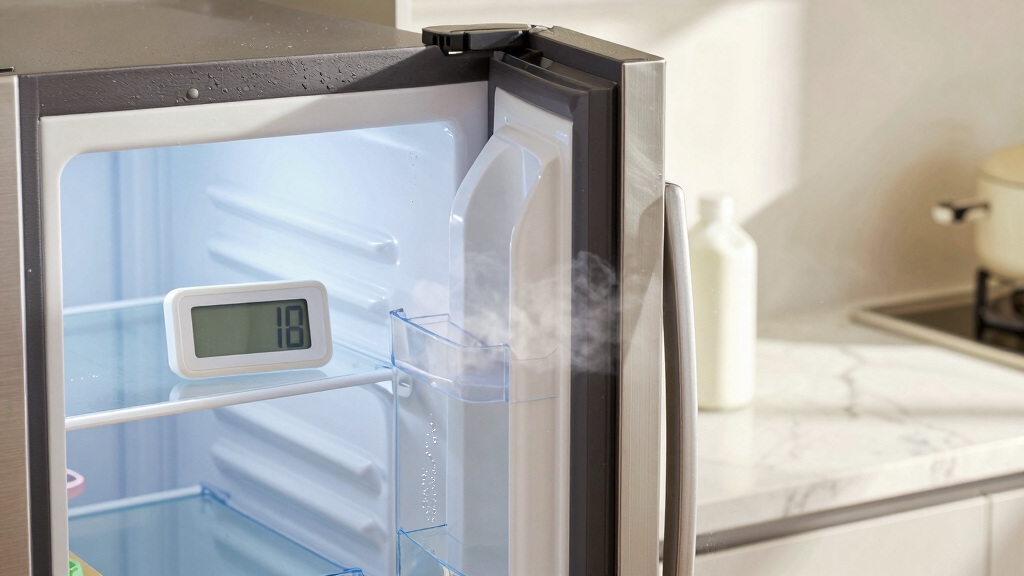
To confirm it’s at the right temperature, use a reliable appliance thermometer placed in the middle of the main compartment.
Target a range between 37°F and 40°F (3°C to 5°C).
Avoid relying solely on the built-in thermostat settings, as they may not reflect actual internal conditions.
Check the temperature after 24 hours of operation, allowing the fridge to stabilize fully.
Additionally, secure minimal door openings during this period to prevent temperature fluctuations.
If the thermometer reads above 40°F, adjust the temperature setting one notch colder and wait another 24 hours before retesting.
Maintaining this precise temperature range prevents bacterial growth and ensures peak food preservation.
What to Expect From Ice Production in the First 24 Hours?
Sure! Here’s a more conversational version of the text:
—
So, what can you expect when you start making ice? Well, the initial ice formation kicks off once your freezer hits around 0°F. This usually happens within the first few hours, but it tends to stabilize more around the 24-hour mark.
Ice production happens in batches, typically every three hours.
Over the next few days, you’ll see the ice bin gradually fill up. Just a quick tip: try to keep that freezer door closed! It helps maintain consistent temperatures, which is key for optimizing your ice output during this time.
—
Let me know if you need any more adjustments!
Initial Ice Formation
Expect initial ice formation to begin only after your refrigerator reaches its ideal temperature, typically within the first 24 hours.
Until the freezer stabilizes at 0°F, ice makers won’t start producing ice efficiently. During this period, the system expels residual heat and establishes a stable cooling environment.
Keep these points in mind:
Ice production initiates once the freezer temperature consistently hits 0°F (−18°C).
The first ice batch may take up to 3 hours post-stabilization to form.
Frequent door openings or loading warm items delay ice formation by disrupting temperature equilibrium.
Ice Production Timeline
Ice production kicks off only after the freezer reaches a stable 0°F, typically within the first 24 hours of operation.
During this period, the ice maker begins cycling water into the tray, freezing it in batches approximately every three hours.
You’ll notice initial ice cubes forming around the 6 to 8-hour mark, but full production capacity may take up to 24 hours to stabilize.
Factors like room temperature, freezer load, and door openings can affect this timeline.
To optimize ice production, keep the freezer sealed and avoid adding warm items during this phase.
Frequently Asked Questions
Can Power Outages Affect the Fridge’s Cooling Time?
Yes, power outages do affect your fridge’s cooling time. When power cuts, the compressor stops, allowing interior temperature to rise.
Once power returns, your fridge must work longer to remove accumulated heat and restore ideal temperature, extending the cooling period.
Frequent outages can strain the compressor, reducing efficiency. To minimize impact, avoid opening the door during outages.
Ensure a stable power supply to maintain consistent cooling performance and protect food safety.
How Often Should Fridge Temperature Settings Be Adjusted?
Think of your fridge like a finely tuned instrument. You shouldn’t adjust it more often than necessary.
Typically, you should only tweak the temperature settings once every 24 hours. This allows the appliance to stabilize after each change.
If you adjust more frequently, you risk inaccurate readings and inefficient cooling. Make small, incremental changes and wait a full day.
Guarantee the door stays closed to maintain consistent internal temperatures and peak food safety.
Are There Any Signs of Malfunction if Cooling Takes Too Long?
If your fridge takes excessively long to cool, watch for symptoms like persistent warm temperatures, unusual noises, or frost buildup on coils.
Frequent compressor cycling or a constantly running motor can indicate issues.
Also, check if door seals are intact; damaged seals reduce efficiency.
If internal lights stay on or vents are blocked, cooling suffers.
These signs suggest potential malfunctions requiring professional inspection or maintenance to restore proper function.
Does the Type of Refrigerant Impact Cooling Speed?
Think of refrigerant as your fridge’s bloodstream; it carries cooling power throughout. It carries cooling power throughout.
Yes, the type of refrigerant directly impacts cooling speed.
Modern refrigerants like R-600a and R-134a offer higher efficiency and faster heat absorption compared to older types. This means your fridge reaches peak temperature quicker.
Choosing the right refrigerant improves thermal conductivity and energy efficiency. It reduces cooling time and ensures stable performance under various conditions.
How Does Energy Consumption Vary During the Initial Cooling Phase?
During the initial cooling phase, energy consumption spikes as your fridge works harder to remove interior heat and stabilize temperatures.
You’ll notice higher power draw until it reaches the target 37°F in the fridge and 0°F in the freezer.
Modern Energy Star models optimize efficiency, reducing energy use faster than older units.
To minimize consumption, avoid overloading warm items or frequent door openings. This prolongs the cooling cycle and increases electricity use.
Where Proper Cooling Begins with Patience
You might expect your fridge to chill instantly, but it actually takes several hours to reach the ideal temperature. Patience is key.
Factors like room temperature, fridge load, and initial setup all play precise roles in cooling time.
So, while you’re keenly waiting for that cold drink, remember: your fridge isn’t a magic box. It’s a complex system that needs time to stabilize and perform at its best. Ironically, rushing only delays the chill.