
How to Make Large Curd Cottage Cheese: Easy Recipe Guide
To make large curd cottage cheese, start with high-quality whole, non-homogenized milk at 86°F to optimize coagulation.
Add mesophilic culture and dissolve rennet evenly. Let curds form undisturbed before cutting into uniform 1/2-inch cubes.
Slowly heat curds to 110°F while stirring gently to prevent matting. Drain and rinse curds in cold water, then season with salt and fold in cream for a rich, tender texture.
Precise control of each step guarantees distinct, creamy curds. Explore detailed techniques to refine your process.
Key Takeaways
- Use non-homogenized whole milk and add 6 tablespoons of cream for richer, larger curds with a creamy texture.
- Heat milk to 86°F (30°C) before adding mesophilic culture and rennet for optimal curd formation.
- Cut curds into 1/2 to 3/4 inch cubes with uniform spacing to ensure large, distinct curds.
- Gradually heat curds to 110°F (43.5°C) over 30 minutes and hold to firm curds without breaking them.
- Drain curds gently, rinse in cold water, then fold in warmed cream and salt to enhance texture and flavor.
Choosing the Best Milk for Large Curd Cottage Cheese

When making large curd cottage cheese, selecting the right milk is crucial to achieving ideal curd structure and flavor.
You should opt for whole milk due to its higher fat content, which enhances richness.
Non-homogenized milk is preferable as it promotes the formation of larger, distinct curds by preserving the cream layer.
Choosing non-homogenized milk helps create larger, well-defined curds by keeping the cream intact.
Make certain the milk is pasteurized but not ultra-pasteurized; UHT treatments denature proteins, impairing coagulation and curd development.
Before adding any culture or rennet, bring the milk temperature to precisely 86°F (30°C) to optimize enzyme activity and bacterial growth.
Avoid ultra-pasteurized milk altogether as it interferes with the coagulation process, resulting in poor curd formation.
Proper milk selection and preparation set the foundation for successful large curd cottage cheese production.
Unopened ricotta cheese can be frozen directly in its original packaging for up to two months, making it a handy option to keep similar dairy products on hand freezing ricotta.
Acidifying and Coagulating Milk for Large Curd Cheese
Begin acidifying your milk by adding a mesophilic culture or sour cream to initiate the fermentation process essential for curd development.
Make certain the milk temperature is at 86°F (30°C) before inoculation to maximize bacterial activity. Allow the milk to ferment undisturbed for 5 to 8 hours, enabling sufficient acidification that lowers pH and enhances curd firmness.
Prepare rennet by dissolving 1/4 tablet in two tablespoons of cool, non-chlorinated water. Whisk the rennet solution thoroughly into the acidified milk for 5 minutes to guarantee even enzyme distribution.
Maintain the mixture at 70°F (21°C) for about 20 hours, during which the milk coagulates into a firm, semi-solid curd. Monitoring temperature and timing precisely at this stage ensures ideal curd structure for subsequent processing.
Place the coagulating milk in a ventilated area away from direct heat sources to help regulate temperature and reduce the risk of overheating.
Cutting and Firming Large Curds
Start by making parallel cuts into the set curd, spacing them between 1/2 and 3/4 inch apart to create uniform sections.
Next, rotate the pot 90 degrees and cut again at the same spacing to form a checkerboard pattern.
Use a ladle to gently cut crosswise, producing roughly 1/2 inch curd cubes.
After cutting, allow the curds to firm for 15 minutes undisturbed, which promotes proper whey expulsion and curd consolidation.
During this period, avoid stirring to prevent curds from breaking prematurely.
Once firmed, begin gentle stirring to keep curds separate and prevent matting.
This controlled handling preserves curd integrity, essential for large curd cottage cheese texture.
Precise cutting and firming make certain curds cook evenly in subsequent steps, maintaining their size and structure.
Always handle any cheesecloth used in straining with care and clean it thoroughly after use to prevent contamination and maintain food safety.
Controlling Temperature When Cooking Curds
When you’re cooking curds, it’s important to be gentle with the temperature. Start by gradually raising it—try increasing it by just 2 to 3°F every five minutes. This slow approach helps prevent any damage to the curds.
Your goal is to reach 110°F within about 30 minutes. Once you hit that mark, you’ll want to hold that temperature steady for around 45 minutes. This step is key for achieving the perfect firmness in your curds.
If you find that the curds are still a bit too soft, don’t worry! You can extend the cooking time to 90 minutes or even longer if needed. Just keep an eye on them to ensure they develop the right texture. Happy cooking!
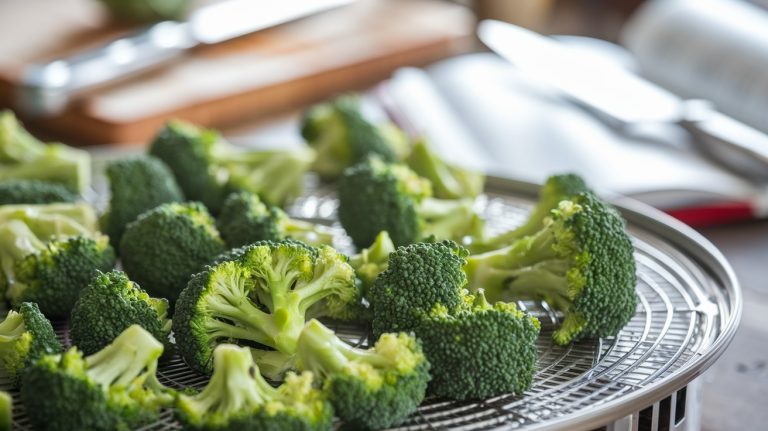
Dehydrating curds can help extend shelf life and concentrate flavors, so consider using a dehydrator with adjustable temperature controls for precise finishing.
Gradual Temperature Increase
Although it requires patience, gradually increasing the temperature when cooking curds is essential to developing the proper texture and firmness in large curd cottage cheese.
You’ll want to raise the heat slowly to prevent curds from shrinking or toughening prematurely.
Follow these precise steps:
- Increase the temperature by 2-3°F (1°C) every 5 minutes to allow uniform heat penetration.
- Continue this incremental rise until reaching 110°F (43.5°C) over approximately 30 minutes.
- Maintain 110°F for an additional 45 minutes to promote consistent curd firming without overcooking.
This controlled temperature ramp guarantees curds develop a large, tender structure vital for cottage cheese.
Avoid rapid temperature jumps that cause uneven curd texture or excessive whey expulsion, which compromises final product quality.
To help maintain consistent conditions during the process, consider using a reliable constant temperature method such as a calibrated thermometer or controlled heating device.
Optimal Cooking Duration
When controlling the temperature during curd cooking, monitoring the duration is equally critical to achieving the desired curd firmness.
You’ll raise the temperature gradually to 110°F (43.5°C) over 30 minutes, then maintain this temperature for an additional 45 minutes.
This total cooking time between 60 to 90 minutes allows the curds to firm up properly without overcooking.
If your curds remain too soft, extend cooking up to 2 hours, but watch carefully to avoid excessive hardening.
Consistent temperature and precise timing guarantee proper whey expulsion and curd texture.
Use a reliable thermometer and timer, and stir gently to prevent curd matting.
Regular temperature monitoring can help prevent overheating and ensure consistent results.
Draining and Washing Curds
During the draining and washing stage, you’ll transfer the curds and whey into a cheesecloth-lined colander to efficiently separate the liquid.
Begin by allowing the curds to drain for 5 to 10 minutes, stirring occasionally to prevent matting and assure even moisture release.
Next, dunk the curd bundle into ice-cold water for at least 3 minutes. This washing step drops the curd temperature to about 60°F (15.5°C), halting fermentation and firming the curds.
Finally, separate the curds well in the cold water to promote even cooling and drainage.
Follow these key steps:
- Drain curds in cheesecloth-lined colander with gentle stirring.
- Submerge curds in ice water to lower temperature rapidly.
- Separate curds thoroughly in cold water for uniform texture and moisture content.
For safe storage of any leftover curds, transfer them into clean, sanitized containers and seal promptly after cooling, using sanitized jars to reduce contamination.
Seasoning and Creaming Large Curd Cottage Cheese
To kick things off, grab yourself a teaspoon of salt, along with any herbs or spices you like. This is where you can really tailor the flavor to your taste!
Once you’ve got that in, it’s time to add six tablespoons of cream. This will help loosen up those curds and give you that creamy texture we’re aiming for.
And don’t forget, after you’ve mixed everything together, pop the cheese into a sealed container. This step is key—it lets the flavors develop while keeping everything nice and fresh. Enjoy!
Fresh, high-quality dairy helps ensure a clean flavor and longer shelf life for your cottage cheese, similar to how sealed for freshness packaging preserves dried beans.
Flavor Enhancements
Frequently, seasoning and creaming play a pivotal role in enhancing the flavor and texture of large curd cottage cheese.
You’ll want to carefully balance flavor additions without compromising the curds’ integrity. Start by adding salt to taste; it not only boosts flavor but also acts as a preservative.
Next, incorporate herbs or spices, such as chives or black pepper, for nuanced flavor profiles. Finally, stir in cream to loosen compressed curds and improve mouthfeel without breaking them down excessively.
To optimize flavor enhancement, follow these steps:
- Add a precise teaspoon of salt or desired seasoning for consistent taste.
- Gently fold in 6 tablespoons of cream to achieve a creamy texture.
- Store in a sealed container to allow flavors to meld while preserving curd structure.
For a richer mouthfeel, consider gently warming the cream before folding it in to help create a silkier consistency and avoid overworking the curds, especially when using heavy cream.
Cream Integration
Building on seasoning to enhance flavor, cream integration plays a vital role in refining the texture of large curd cottage cheese. You’ll add about 6 tablespoons of cream to the salted curds, which breaks up the compressed curds and creates a smooth, creamy consistency.
Adjust cream quantity to achieve your desired moisture and mouthfeel, maintaining balance between richness and curd integrity. Stir gently but thoroughly to ensure even distribution without damaging curd structure. Using higher‑fat dairy can improve tenderness and mouthfeel, so consider cream options with richer fat content for a softer result and enhanced richness.
| Cream Amount (Tbsp) | Texture Effect | Flavor Impact |
|---|---|---|
| 4 | Slightly creamy | Mild richness |
| 6 | Smooth, creamy | Balanced, rich |
| 8 | Very creamy | Enhanced richness |
| 10 | Almost whipped | Intensified flavor |
This precise cream integration is essential for peak texture and taste.
Storage Tips
When seasoning and creaming large curd cottage cheese, proper storage is essential to preserve both texture and flavor.
After adding salt, herbs, and cream to break up compressed curds, place your cheese in a sealable container to maintain freshness and prevent contamination.
Refrigerate promptly to slow bacterial growth and enzymatic activity, which can alter taste and texture.
Follow these key storage tips:
- Store at 34–40°F (1–4°C) to maintain ideal curd firmness and flavor stability.
- Use an airtight container to block moisture loss and external odors.
- Add a few tablespoons of cream before serving if the curds dry out during storage.
Storing Large Curd Cottage Cheese
Ensuring proper storage of large curd cottage cheese is essential to preserve its texture and flavor.
Proper storage of large curd cottage cheese is key to maintaining its texture and fresh flavor.
You should place the finished cheese in an airtight container to prevent moisture loss and contamination.
Refrigerate it promptly at temperatures between 34°F and 40°F (1°C to 4°C) to inhibit bacterial growth and enzymatic activity.
Adding a few tablespoons of cream before sealing the container helps maintain desired consistency and reduces curd compression.
Avoid storing the cheese near strong-smelling foods to prevent flavor absorption.
Use the cheese within 5 to 7 days for peak freshness and quality.
Always handle the cheese with clean utensils to minimize microbial introduction.
Proper storage guarantees your large curd cottage cheese retains its characteristic softness, moisture balance, and fresh taste throughout its shelf life.
Troubleshooting Large Curd Cottage Cheese Problems
Proper storage preserves large curd cottage cheese’s texture and flavor, but issues can still arise during production.
If your curds are too small or crumbly, check that you used non-homogenized whole milk and maintained the correct coagulation temperature (86°F).
Insufficient rennet or uneven cutting can also cause poor curd formation. To troubleshoot:
- Verify milk temperature and rennet quantity. Incorrect levels lead to weak coagulation.
- Make sure cuts are uniform and spaced 1/2 to 3/4 inch apart to avoid curd matting.
- Monitor cooking temperature carefully, raising it slowly to 110°F. Overheating hardens curds.
Frequently Asked Questions
Can I Use Low-Fat Milk for Large Curd Cottage Cheese?
You can use low-fat milk for large curd cottage cheese, but expect less rich flavor and smaller curd size.
The lower fat content reduces curd firmness and creaminess. To improve curd formation, consider adding a small amount of cream during creaming.
Whole, non-homogenized milk remains ideal for producing larger, distinct curds. If you use low-fat milk, closely monitor acidification and coagulation times to achieve the best texture possible.
How Do I Know When to Add Rennet Precisely?
Timing is everything, as the saying goes. You’ll want to add rennet precisely when your milk reaches 86°F (30°C).
Before adding it, make sure you’ve stirred in the mesophilic culture and let the milk rest for 5 to 8 hours to initiate acidification.
Then, dissolve 1/4 tablet of rennet in two tablespoons of cool water and whisk it into the milk thoroughly for 5 minutes to guarantee even coagulation.
What Is the Best Way to Clean Equipment Before Cheesemaking?
You should clean your cheesemaking equipment with hot water and a food-safe detergent immediately after use to prevent residue buildup. Rinse thoroughly to remove all detergent traces.
Sanitize with a solution of diluted bleach or a commercial sanitizer approved for dairy use. Then air dry or use clean towels.
Avoid harsh chemicals or abrasive materials that can damage surfaces and harbor bacteria. Proper cleaning guarantees hygienic conditions for consistent, safe cheese production.
Can I Flavor Cottage Cheese With Fruits or Sweeteners?
Yes, you can flavor cottage cheese with fruits or sweeteners. After draining and cooling the curds, gently fold in fresh or dried fruits and natural sweeteners like honey or maple syrup.
Make sure the additions are evenly distributed without breaking the curds. Adjust sweetness gradually to maintain the cheese’s texture and flavor balance.
Store the flavored cottage cheese in a sealed container under refrigeration to preserve freshness and prevent spoilage.
How Long Can Homemade Cottage Cheese Be Kept Frozen?
You can keep homemade cottage cheese frozen for up to two months without significant loss of quality.
Beyond that, texture and flavor may degrade due to ice crystal formation disrupting curd structure.
Make sure to store it in an airtight, freezer-safe container to prevent freezer burn.
When ready to use, thaw it slowly in the refrigerator to maintain texture as much as possible.
Avoid refreezing after thawing to preserve quality.
Create Perfect Large Curd Cottage Cheese Every Time
Now that you’ve mastered each step, making large curd cottage cheese becomes as straightforward as following a recipe.
Think of the process like tuning an instrument. Precision in temperature, timing, and technique guarantees your curds sing with the perfect texture and flavor.
By choosing quality milk, carefully coagulating, cutting, and handling curds, you’ll consistently craft cottage cheese that’s creamy, firm, and deliciously fresh.
Keep troubleshooting tips handy to fine-tune your results every time.